Looking for innovation
Get in touch today
Home - USBL
USBL system

What is USBL?

Quick definition: USBL stands for Ultra Short Baseline - a type of underwater positioning system using acoustic signals to track underwater targets such as ROVs, AUVs, divers and towfish with real-time accuracy.

What is a USBL used for?

“USBL systems are essential tools for subsea operations in water depths ranging from just a few metres to over 4,000.” – Ben Darling, Product Line Manager (Acoustic Positioning) and Support Engineer.

USBL systems are used to determine the position of underwater vehicles or instruments relative to a surface vessel. USBL systems are widely used to track and position:

  • Remotely Operated Vehicles (ROVs)
  • Autonomous Underwater Vehicles (AUVs)
  • Divers
  • Underwater equipment and structures (fixed or mobile)
  • Surface vessels (as a reference tool). [DP vessel Station keeping]
  • Seabed mapping missions

Commonly deployed in industries such as offshore wind, oil and gas, marine research, military operations and geotechnical surveying, USBLs help teams explore, inspect, repair and maintain subsea assets with accuracy and efficiency.

Applications of USBL:

off-shore wind

Offshore

Offshore infrastructure surveys
Military Diver

Monitoring and tracking

Diver monitoring and safety ROV and AUV tracking Position reference for dynamic positioning (DP) vessels

Surveys and exploration

Seabed exploration and mapping Cable and pipeline inspection

How does USBL positioning work?

A USBL system typically includes three key components:

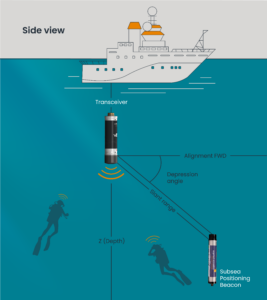
  • Acoustic Positioning Beacon attached to the underwater target aka transponder beacon
  • Transceiver, mounted on the vessel via a pole or trailing cable
  • Topside unit, processing data and displaying the target’s location

Here’s how USBL systems work:

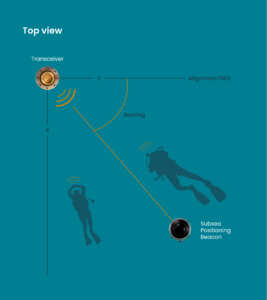
  1. The transceiver sends a unique acoustic pulse to the positioning beacon, which detects the interrogation and then replies.
  2. The system calculates the range (based on travel time) and direction of arrival (DoA) compromising bearing and depression angle (based on phase differences between hydrophone elements) of the return signal.
  3. The result: a real-time 3D position of the subsea target relative to the vessel, coupling with surface GPS position will give real world accurate location.

To ensure precision, USBL systems must account for sound velocity changes in water, which vary with temperature, salinity and pressure. A dedicated sound velocity probe should be used for accurate calibration.

USBL calibration side viewUSBL calibration

What is the frequency of USBL?

USBL systems operate across various frequency bands:

  • 18–36 kHz for long-range, lower-resolution tracking
  • 36–110 kHz for shorter-range, high-accuracy applications

The right frequency depends on depth, target size and operational requirements.

All of our products are in the 18–34 kHz range.

What is the procedure for USBL calibration?

USBL systems require calibration to account for the physical offset between the USBL transceiver and the vessel’s reference frame. The basic calibration procedure involves:

  1. Interface external sensors, gyro, GNSS, etc to your fixed mount USBL system
  2. Collect a sound velocity profile using a dedicated probe to factor in environmental variables
  3. Deploy a beacon at a fixed depth and position on the seabed
  4. Sailing a defined pattern around the fixed beacon (the deeper the water the better the pattern, this should not exceed a radius of 2x water depth)
  5. Acoustic positional data is then collected and processed to calculate the angular and rotational offsets between the USBL transceiver and vessel frame.

Regular calibration ensures accurate positioning, particularly when using USBL data for critical subsea work or survey-grade applications.

USBL calibration side viewUSBL calibration

When should you perform a USBL calibration?

Typically, an acoustic calibration should be performed when anything in the USBL system alignment changes, for example a new transceiver installation, removing and servicing external sensors, or changing the mounting configuration.

For permanent vessel installations, we recommend an acoustic calibration every 12 months and results analysed historically to provide system repeatability confidence.

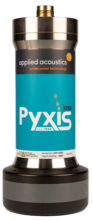
The exception to this is Pyxis, which is a combined INS and USBL system.

USBL vs LBL: What’s the difference?

USBL is ideal for fast mobilisation, while LBL can be used for long-term or ultra-precise operations, usually in deep water.

Feature USBL LBL
Measurement baseline Short (typically <30cm within a single transceiver) Long (typically > 100m with multiple seabed beacons)
Accuracy Moderate – high Very high
Setup time Quick, minimal infrastructure Slower, requires seabed infrastructure
Applications Hydrographic subsea surveys High precision subsea positioning (e.g., metrology)
Portability High (compact, vessel-based) Low (requires fixed infrastructure)

What are the benefits of using USBL positioning?

“The key advantage of a USBL over other types of subsea positioning (such as LBL arrays) is their convenience. They can be quickly deployed from the surface and there is no need for any additional equipment to be deployed subsea.” – Ben Darling, Product Line Manager

  • Easy to deploy​
  • ​Quick to mobilise​
  • Minimal setup​
  • Reduced time of calibration​
  • Ideal for shallow applications​
  • Cheaper than SBL and LBL systems​
  • Repeatable​

What USBL equipment​ is needed?

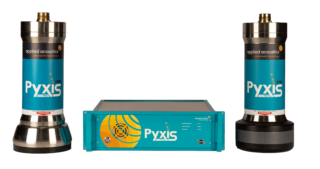
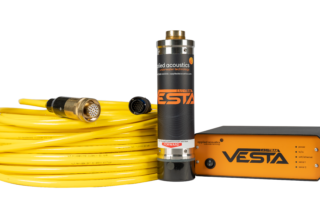
A USBL System comprises four parts for minimum operation: ​

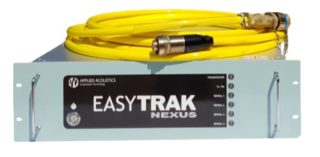
  • System computer: The top side control box and computational computer calculates the position based on the values and data that are returned from the transceiver and then outputs to the survey PC or end location of the data.​The system computer controls the Tx from the transceiver and the timing of responses. It can also take in additional data such as GNSS and external motion data to aid in the calculation of position and provide Geo-referenced outputs.​
  • Deck cable: Used to link the system computer to the transceiver.​
  • Transceiver: Installed subsea, the transceiver transmits and detects the reply of the positioning beacon (target) being tracked. The transceiver is fitted with the ​
  • Positioning Beacon: A positioning beacon is fitted to the target being tracked and will receive the transmitted signal from the transceiver and respond.

How does USBL transceiver installation work?

The mounting of a USBL transceiver depends on the subsea tracking application and performance requirements.

When a vessel is stationary or the transceiver is deployed from a quayside it can be free hung. Typically, this is for lower positional accuracy applications as transceiver stability is reduced and internal AHRS sensors are used. 

Applications where a transceiver may be free hung include driver tracking from small craft using the EZT-2687, ETM-904 or ETM-905 transceivers. Transceiver stability can be aided by using forward and aft stays to reduce rotational effects.

For improved performance on transiting vessel applications the USBL transceiver is mounted using a rigid pole attached to the vessel. These include Over the side (OTS) mount, thru moon pool and gate valve deployment installations.

Rigid pole installations improve positional performance by stabilising the transceiver, providing a fixed reference for acoustic and peripheral systems to be calibrated to during installation. 

A fixed mount installation allows operators to achieve survey grade performance from our USBL transceivers, including EZT-2687, 2780 and 2782.  Fixed mount installations are vital for the Easytrak Pyxis system providing a fixed vessel frame for INS operations.

A common way to install the USBL transceiver is an over the side (OTS) pole mounted system, particularly on vessels of opportunity or smaller craft. For all fixed mount installations, the transceiver is aligned to the bow of the vessel using the keyed hardware brackets and alignment mark for reference.

​Tranceiver depth: The transceiver must be installed at least 1m below the hull of the vessel, although we recommend further if possible. This is to ensure a clear hemispherical view of the ocean and to avoid interference from reflections off the hull of the vessel and multipath from the sea surface.

What are USBL meanings and key terms?

USBL

“Ultra-Short Baseline” refers to the small physical distance (less than 30 cm) between hydrophone elements in the transceiver array, enabling compact and efficient positioning.

USBL acoustic positioning

Acoustic positioning refers to the technique of using sound waves to determine underwater location. USBL is one of three common methods (USBL, LBL and SBL).

USBL underwater positioning system

An underwater positioning solution used to track assets in real time, essential for offshore operations involving vehicles, divers and instrumentation.

USBL transponder

A transponder is an underwater device that responds to an interrogation ping from the USBL system, allowing the system to calculate its position.

USBL transceiver

A transceiver is the sensing instrument and electronics that houses a multi-element array that’s typically installed on the vessel and deployed subsea. It interrogates the transponder beacon and detects and processes the signals received back to determine range, bearing and depression angle.

USBL navigation

Used to guide and monitor subsea assets during operations. Positioning data is often integrated into vessel navigation and mission control software.

USBL beacon

A subsea instrument used to send acoustic responses back to a USBL tranceiver. It can operate in a transponder or responder mode. It can be fixed on a diver, ROV or placed on the seabed as a reference point. Can remain active beyond normal operations to allow recovery of lost equipment.

USBL communication

Some USBL systems allow telemetry, such as vehicle health data or sensor readings, between subsea units and the surface.

USBL ROV

USBL systems are key for tracking ROVs (Remotely Operated Vehicles) during offshore inspection, survey and construction operations. Helping operators know the exact subsea position of the vehicle in real time.

USBL Terminology

  • Slant Range​
  • Depression angle​
  • Bearing​
  • Transmit (Tx)​
  • Receive (Rx)​
8th February, 2026 | 0 minute read
By Ben Darling, Product Line Manager (Acoustic Positioning) and Support Engineer

Ben joined applied acoustics at the age of 16, working during his college holidays. At 18 he joined the production team full time, where he built and tested acoustic positioning products whilst studying for his Electronics HND. After three years he moved into repairs, working across the product range while studying for his second HND in Business Management.

Sources and References

    1. International Marine Contractors Association, Guidance on vessel USBL systems for use in offshore survey, positioning and DP operations, Revision 1.1 – March 2017
    2. How do Ultra Short Baseline Systems work
    3. The easytrak USBL product range
    4. Traditional vs closely coupled USBL solutions
    5. Shallow water USBLs

Enquire about award-winning solutions for the marine industry

    MiniPods
    Release Beacons
    Positioning Beacons
    Easytrak USBL Systems
    Geophysical Survey Systems
    Sound Source, Sparkers


    ?>