SEP Hydrographic
- SEP Hydrographic
- 1 year


SEP Hydrographic operates their own dedicated vessel, Pulsar, the company provides essential services including cable route and offshore wind survey, asset inspection and scour monitoring.

Lengthy calibrations and risky environments
As a specialist operating on small vessels in nearshore environments, SEP Hydrographic constantly seeks to maximise operational efficiencies. The primary challenge they had was the time and risk associated with manual Ultra-Short Baseline (USBL) beacon deployments and recoveries.
Before adopting our solution, SEP Hydrographic was using USBL systems that required a full calibration, which meant deploying an acoustic beacon onto the seabed.
This process presented several challenges:
- Time: The calibration often consumed a full day of the vessel’s mobilisation.
- Weather risk: Calibration requires specific states of tide and good weather. Waiting for ideal conditions often prolonged mobilisation periods, increasing costs.
- Safety: Deploying and recovering the USBL beacon manually from small vessels carries a safety risk for the team.
SEP Hydrographic needed an agile solution that could cut mobilisation time while increasing safety and maintaining industry-leading accuracy.

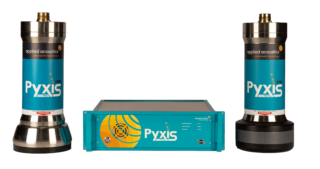
Our solution: Pyxis INS + USBL
Having been impressed by a demonstration at Ocean Business, SEP Hydrographic contacted us, intrigued by the factory-calibrated aspect of the Pyxis INS + USBL system.
Pyxis combines high-performance USBL technology with an advanced Inertial Navigation System (INS). This unique coupling means all acoustic and chassis alignments are calibrated in the factory, the only field requirement is installation-specific INS alignment.
As they no longer needed to deploy a beacon on the seabed, we were able to provide SEP Hydrographic with a solution that is safer, agile and more efficient.

Safer operations and sub-meter accuracy
The implementation of Pyxis has fundamentally changed SEP Hydrographic’s process, immediately delivering significant, quantifiable improvements in efficiency and safety.
Results:
- Mobilisation time – Average saving of one day
- Operational safety – Eliminating deployment on the seabed significantly reduced associated safety risks.
- Weather risk – Eliminating the need to wait for good weather for calibration lead to a reduction of vessel mobilisation delays.
- Data accuracy – Achieved sub-meter accuracy when resolving raw Side Scan Sonar (SSS) positioning.
- Data accuracy – Average SSS positional accuracy improved from ±1.07m using a competing USBL system to ±0.92m post SSS box in positional verification with the Pyxis system.
By choosing a trusted technology partner, SEP Hydrographic has increased their operational throughput, reduced risk for their teams and maintained the exceptional data quality their clients expect.